
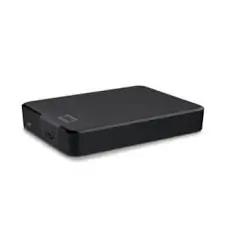
Is your 1TB or 2TB external drive already full, and you’re dreading the hassle of juggling multiple drives? Do you need to archive a massive video project, back up an entire media server, or carry an enormous digital library with you? What if you could pack a staggering 6TB of storage into a single, portable device? I’m reviewing the WD 6TB Elements Portable Hard Drive, a product that pushes the boundaries of what’s possible in a 2.5-inch portable form factor. As a data hoarder and tech reviewer who manages multiple terabytes, I’m testing whether this “world’s first” is a practical marvel or a compromised gimmick.
Who Is the WD 6TB Elements Portable Hard Drive For?
This is a high-capacity specialist drive for users who need maximum portable storage in a single, simple package. It solves a very specific problem of sheer volume.
The Ideal Customer:
- Content Creators & Videographers: If you shoot in 4K/8K and need to archive raw footage or completed projects, 6TB in one drive is a game-changer for organization and portability.
- PC & Console Gamers with Massive Libraries: For those with hundreds of games across Steam, Epic, or console platforms, this offers a way to keep your entire library installed and ready without deleting anything.
- Media Hoarders & Home Server Users: Perfect for consolidating movie/TV show collections, music libraries, and photo archives into one portable unit for backup or transport.
- Professionals Needing Large Local Backups: Graphic designers, architects, and researchers who work with huge files can use this for a comprehensive, portable backup of their primary system.
- Traveling Professionals with Extensive Data: Those who need to carry vast amounts of data (presentations, client files, media) securely in a single device.
Who Should Look Elsewhere:
- Casual Users & Basic Backup Needs: If you only need to back up documents and family photos, a 1TB or 2TB drive is more than enough and significantly cheaper.
- Those Prioritizing Speed Over Capacity: This is a mechanical hard drive (HDD). For active video editing or running programs, a slower 6TB HDD will feel sluggish compared to a smaller, faster SSD.
- Users in Physically Demanding Environments: While portable, it’s a mechanical drive packed with dense platters. It’s more sensitive to shock and vibration than lower-capacity 2.5″ drives or SSDs.
- The Ultra-Budget Conscious: You pay a premium for the cutting-edge density. The cost per terabyte is higher than buying two 4TB drives.
WD 6TB Elements Portable External Hard Drive: At a Glance
[INSERT HIGH-QUALITY IMAGE/VIDEO OF THE DRIVE, HIGHLIGHTING ITS SIZE COMPARED TO A SMALLER 2TB DRIVE]
| Aspect | Details |
|---|---|
| Product Name | WD Elements 6TB Portable External Hard Drive |
| Key Features | World’s First 6TB in 2.5″ Form Factor, USB 3.2 Gen 1, Plug-and-Play, No External Power |
| Form Factor | Portable 2.5-inch HDD (Powered by USB) |
| Best For | Massive Media Archives, Game Libraries, Content Creator Backups, Data Consolidation |
| Price Point | Premium for Capacity (Check latest price on Amazon) |
| Our Rating | ⭐⭐⭐⭐ (4.3 / 5 Stars) |
| Standout | Unmatched storage density in a truly portable, bus-powered package. |
In-Depth WD 6TB Elements Review
Appearance & Design: Deceptively Normal, Surprisingly Dense
At first glance, the WD 6TB Elements looks like any other portable hard drive—a sleek, black plastic rectangle with a matte finish. However, pick it up, and you immediately notice it’s substantially heavier and thicker than a typical 2TB or 4TB portable drive. This is the physical trade-off for cramming 6TB into the 2.5-inch form factor. It’s still portable and doesn’t require a power brick, but it occupies more space in your bag and has a noticeable heft. Build quality is standard WD: functional, minimalist, and robust enough for careful handling.
Performance & Features: A One-Trick Powerhouse
This drive has one job: store a colossal amount of data simply and reliably.
- 6TB CAPACITY & DENSITY: The headline feature is mind-boggling. 6TB in a bus-powered 2.5-inch drive is an engineering feat. This capacity allows for truly monolithic backups or archives. You could store approximately: 1.5 million photos, 1,500 hours of HD video, or 150+ modern AAA PC games with room to spare.
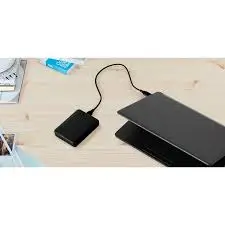
- PLUG-AND-PLAY SIMPLICITY: Like all WD Elements drives, it’s incredibly easy to use. Connect the included USB cable (USB-C to USB-A typically), and it’s instantly recognized by Windows, Mac, or even compatible game consoles (for media storage). No software, no drivers, no fuss. It’s formatted for Windows out of the box; Mac users need to reformat via Disk Utility.
- USB 3.2 GEN 1 (5 Gbps) PERFORMANCE: Don’t expect SSD speeds. As a high-density mechanical drive, performance is similar to other portable HDDs. You’ll get sequential read/write speeds of 100-130 MB/s, which is fine for transferring large media files or backups but slow for active work. The interface is not the bottleneck; the spinning platters are.
- NO EXTERNAL POWER REQUIRED: The fact that this drive draws all its power from a single USB port is impressive, given its internal complexity. It worked flawlessly on modern laptops and desktops without needing a dual-USB “Y-cable” for extra power.
User-Friendliness: Effortless for Its Complexity
Using it is as simple as storage gets. The only potential “complexity” is for Mac users needing to reformat, which is a standard, one-time process. There are no buttons, switches, or software to configure. It’s a dumb storage vessel in the best possible way.
Durability & Quality: Handle with Extra Care
This is the most important consideration. Packing so much data into a small, portable chassis means the platters are incredibly dense. While WD builds it to standard specifications, this drive is more sensitive to physical shock than a lower-capacity 2.5″ drive or an SSD. You must treat it with care. Avoid drops, bumps, or using it on an unstable surface while it’s operating. It’s best suited for stationary backup or gentle transport in a padded case, not for tossing in a backpack with heavy books.
Value for Money: Paying for the Frontier
The value for money is niche. You are paying a premium for extreme density and convenience. The cost per terabyte is higher than buying multiple smaller drives. However, the value lies in simplicity and consolidation. For a video editor who needs to archive three 2TB projects, carrying one drive is far simpler and less error-prone than three. For the user who needs this specific solution, the premium is justifiable.
Pros & Cons: The Balanced Verdict
Pros:
- Unprecedented 6TB capacity in a standard portable 2.5-inch form factor.
- True plug-and-play simplicity with no external power required.
- Massively simplifies data consolidation—one drive instead of many.
- Reliable WD performance and build quality.
- Broad compatibility with PCs, Macs, and media devices.
Cons:
- Higher cost per terabyte than multiple smaller drives.
- More physically bulky and heavy than standard portable drives.
- Inherently more fragile due to high platter density; not for rough environments.
- Slow HDD speeds—not for active projects, only for storage/backup.
- Generates more heat during sustained transfers than smaller HDDs.
Alternatives & Comparisons
WD 6TB Elements vs. Two WD 4TB My Passport Drives
This is the core dilemma: one giant drive or multiple smaller ones?
- Two WD 4TB My Passport Drives: Combined 8TB capacity for a similar or lower total cost. Offers redundancy (if one fails, you don’t lose everything) and is more portable/flexible. The My Passport also includes hardware encryption and backup software.
- Why Choose the Single 6TB Elements? Choose the 6TB Elements only if your top priority is having all your data in a single, contiguous volume for simplicity of management, or if you physically need the maximum possible capacity in one device. The “one giant bucket” approach has value for specific workflows. Choose multiple smaller drives for better value, inherent redundancy, and improved durability.
Frequently Asked Questions (FAQ)
Q1: Does it work with PlayStation 5 or Xbox Series X?
A: You can connect it to store PS5 or Xbox Series X|S games for cold storage, but you cannot play next-gen games directly from it due to speed limitations. You must copy games back to the console’s internal SSD to play. For PS4/Xbox One games, you can play them directly. It’s also great for storing media files (movies, music) on consoles.
Q2: Is it louder or hotter than smaller portable drives?
A: Yes, to both. The drive has to work harder to access data across its dense platters, which can result in more audible seeking noises and more heat during prolonged, intensive file transfers. Ensure it has some ventilation.
Q3: Can I use it for Time Machine on Mac?
A: Absolutely, but you must reformat it first. Use macOS Disk Utility to erase the drive and format it as APFS or Mac OS Extended (Journaled). Then you can select it as your Time Machine backup destination. Its huge capacity is perfect for multiple Time Machine snapshots.
Q4: What’s inside? Is it an SSD or HDD?
A: It is definitively a Hard Disk Drive (HDD) with spinning magnetic platters. This is how WD achieves the 6TB capacity at this price point. It is not a Solid State Drive (SSD).
Q5: Should I get a warranty or accident protection?
A: Highly recommended. Given the value of the data and the drive’s sensitivity, extending the standard warranty or adding accident protection (like Amazon’s) is a wise investment. The potential cost of data recovery far exceeds the drive’s price.
Conclusion & Final Call-to-Action
The WD 6TB Elements Portable Hard Drive is an engineering landmark that serves a specific, data-hungry audience perfectly. It delivers on an incredible promise: massive, contiguous storage in a truly portable package. While it carries a premium price, requires gentle handling, and isn’t fast, its ability to consolidate terabytes of data into a single, simple device is unparalleled.
If you are a content creator, hardcore gamer, or digital archivist who is constantly battling storage limits and values simplicity above all else, this drive is a revolutionary tool that solves a massive problem.